China Best Rattan Arm Chair Manufacturers are increasingly assessed by more than attractive catalog images. Buyers now examine cane selection, frame construction, weaving consistency, finishing safety, and long-term comfort. A reliable supplier should explain whether each Rattan Arm Chair uses natural rattan, synthetic PE rattan, or a combination of materials. This detail matters. Natural rattan brings warm variation, while synthetic fibers offer stronger resistance to moisture and sunlight.
Kenneth Cobonpue, a respected designer known for working with natural fibers, has said, “I want to make furniture that is not only functional, but also emotional.” His idea reflects the real value of a well-made Rattan Arm Chair. It should support the back comfortably, feel stable under daily use, and create a visible connection with handcrafted design. During factory evaluation, buyers should inspect joints, armrest symmetry, seat tension, and the edges beneath the cushion. Small inconsistencies can reveal rushed production.
Perfectly identical weaving is not always realistic. Natural rattan may show slight color differences, tiny bends, or uneven texture. These details are not automatically defects. However, loose strands, sharp edges, unstable legs, and uneven coating require attention. A serious manufacturer should provide material samples, production photos, testing information, and clear quality-control records. On-site experience also matters, because a beautiful sample may hide weak internal joints. Comparing prototypes with mass-production units is wise. The best supplier combines responsible sourcing, skilled workmanship, transparent communication, and practical after-sales support. That combination builds trust beyond a polished product page.
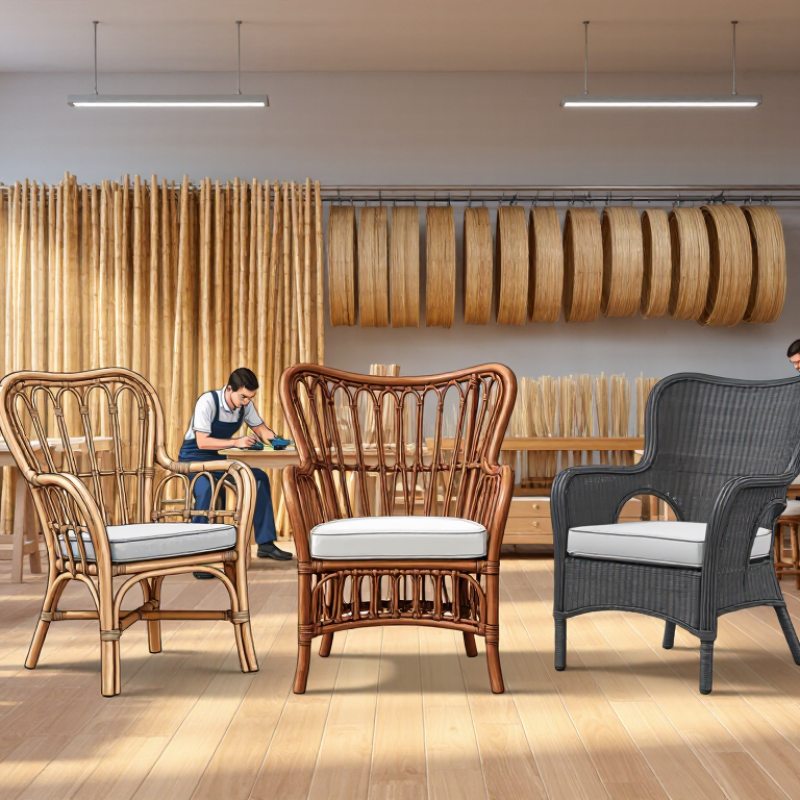
China Best Rattan Arm Chair Manufacturers
What Defines a Leading Rattan Arm Chair Manufacturer in China
A leading rattan arm chair manufacturer combines skilled handwork with controlled factory processes. Experienced teams inspect rattan strips for moisture, flexibility, color, and visible damage. These checks matter before weaving begins.
Strong manufacturers also understand frame engineering. They select treated solid wood, aluminum, or steel according to the chair’s intended environment. Joints should remain firm during repeated movement, not only during showroom inspection. A well-made armchair feels stable when someone shifts weight or rests an elbow.
Details reveal professional discipline. Workers should align the weave, tighten loose sections, and smooth every contact surface. Sample chairs need practical testing, including load checks, rocking tests, and repeated armrest pressure. Production records help connect defects with specific batches.
Consistency is essential.
Reliable suppliers communicate material sources, lead times, packaging methods, and inspection standards clearly. They can provide accurate samples instead of attractive prototypes that production cannot repeat. Export experience also helps with moisture control, carton protection, and documentation requirements.
Still, no workshop is flawless. Natural rattan may show slight color variation, even after careful selection. A responsible manufacturer explains this limitation instead of hiding it. The best partnership includes honest feedback, corrective action, and regular quality reviews. That practical attitude often separates a dependable manufacturer from a factory focused only on low prices.
China Best Rattan Arm Chair Manufacturers
Key Materials and Craftsmanship Used in Rattan Arm Chair Production
Reliable rattan arm chairs begin with carefully selected materials. Natural rattan offers a light frame, flexible fibers, and a warm, organic texture. Manufacturers usually inspect each cane for consistent diameter, clean surfaces, and suitable moisture levels. Poorly dried rattan may shrink, crack, or loosen after assembly. That detail matters.
Many chairs combine rattan with solid wood, engineered wood, or powder-coated metal supports. Solid wood provides a stable structure around the arms and legs. Engineered panels can reduce movement in selected areas. Metal reinforcement may improve strength, but it must be shaped smoothly. Sharp edges can damage the weaving and reduce comfort.
Craftsmanship appears in the smallest decisions. Skilled workers steam and bend rattan gradually, avoiding sudden pressure that creates hidden fractures. They secure joints with dowels, screws, or carefully wrapped fibers. The weaving pattern should remain even across the seat and back. Tension needs balance. Too tight, and the fibers may split; too loose, and the chair can sag.
Experienced production teams sand exposed surfaces by hand before applying water-based or low-odor finishes. These coatings help resist stains while preserving the rattan’s natural character. No handmade surface is perfectly uniform. That is not always a flaw. Still, inconsistent color, rough joints, or visible gaps deserve closer inspection. A careful quality check should test stability, arm strength, weaving tension, and finish adhesion before shipment.
| Production Element | Material or Method | Typical Application | Craftsmanship and Production Details | Quality Considerations | Sustainability or Care Notes |
|---|---|---|---|---|---|
| Main Frame | Natural rattan poles or engineered wood, depending on the chair design | Forms the load-bearing structure, including the back, arms, seat supports, and legs | Poles are cut to length, steamed or heated for bending, shaped around jigs, and secured with joints, dowels, screws, or wrapped rattan strips | Check frame alignment, joint tightness, load stability, smooth surfaces, and absence of deep splits | Natural rattan should be kept away from prolonged moisture and direct sunlight; engineered wood should be protected from water exposure |
| Rattan Cane | Strips made from the outer skin of rattan, commonly called cane | Used for open-weave seats, backs, side panels, and decorative surfaces | Cane is soaked or conditioned for flexibility, then woven through drilled holes, grooves, or a routed frame channel | Look for even spacing, consistent tension, clean edges, and no broken strands or loose sections | Cane is a renewable plant-based material, but its service life is extended by avoiding excessive humidity and impact |
| Core Rattan | Inner rattan core, often processed into round or flat weaving material | Used for wrapping joints, binding frame parts, making decorative patterns, and creating flexible woven panels | Craft workers select matching widths, maintain uniform tension, overlap ends neatly, and trim or tuck the joints to reduce snagging | Inspect for regular texture, secure wrapping, consistent color, and smooth transitions at connection points | Natural variation in color and diameter is normal; dry dusting and a lightly damp cloth are generally safer than soaking |
| Synthetic Weave | Polyethylene or other weather-resistant synthetic wicker fibers | Commonly used for outdoor arm chairs and areas exposed to changing weather conditions | Fibers are hand-woven or machine-assisted around an aluminum, steel, or treated frame, with ends tucked or fastened underneath | Check UV resistance, weave density, edge finishing, color consistency, and resistance to cracking during bending | Can generally be cleaned with mild soap and water; recycling options depend on the specific polymer and local facilities |
| Frame Reinforcement | Steel, stainless steel, aluminum, or additional wood supports | Reinforces legs, seat rails, arm supports, and other high-stress areas | Metal parts may be welded, bolted, or integrated into the frame before the rattan is applied; exposed steel is normally coated to limit corrosion | Verify stable footing, secure fasteners, smooth welds, corrosion protection, and absence of sharp exposed edges | Aluminum is lightweight and corrosion-resistant; steel requires effective surface protection, especially in humid environments |
| Seat Support | Woven cane, webbing, wood seat board, or elastic support system | Supports the cushion or provides a finished seating surface without a cushion | Support materials are tensioned evenly and attached to the frame; a seat board may be shaped and covered before final assembly | Check for even tension, adequate support, no excessive sagging, and a level seating plane | Natural woven seats may loosen with prolonged dampness; cushions should be dried fully after cleaning |
| Adhesives and Fasteners | Wood adhesive, screws, nails, dowels, staples, or concealed clips | Secures frame joints, rattan ends, trim pieces, and upholstery components | Fasteners are positioned to minimize visible marks, while adhesive is applied to clean, properly fitted joint surfaces | Check for firm joints, concealed or neatly finished fasteners, no adhesive residue, and no sharp protrusions | Adhesive selection should match the substrate and expected indoor or outdoor exposure conditions |
| Surface Finish | Water-based coating, clear lacquer, oil, stain, or protective outdoor finish | Enhances appearance and helps protect natural rattan, wood, and woven surfaces from dirt and moderate moisture | Surfaces are sanded, cleaned, coated in controlled layers, and dried between applications to reduce roughness and uneven sheen | Inspect for uniform coverage, smooth touch, consistent color, good adhesion, and absence of runs or blisters | Low-VOC or water-based finishes can reduce odor and solvent emissions; finish performance depends on indoor or outdoor use |
| Cushion and Upholstery | Polyurethane foam, polyester fiber, cotton, linen, polyester, or blended upholstery fabric | Improves comfort and provides a finished seating and back-support surface | Foam is cut to the required profile, wrapped with batting where needed, and enclosed in sewn covers with zippers or other closures | Check foam recovery, seam accuracy, cover fit, zipper operation, fabric strength, and consistent cushion thickness | Removable covers are easier to clean; outdoor textiles should be selected for suitable UV and moisture resistance |
| Edge and Contact Finishing | Rattan binding, rounded wood edges, protective caps, or glides | Finishes arm tops, seat borders, leg ends, and other areas that contact users or flooring | Edges are rounded, sanded, wrapped, or capped to prevent snagging and improve comfort during regular use | Run a hand over contact areas to detect rough fibers, splinters, sharp corners, or unstable foot glides | Replace worn glides promptly to protect floors and prevent uneven loading of the chair frame |
| Final Inspection | Dimensional, visual, functional, and packaging checks | Confirms that the completed arm chair is safe, stable, visually consistent, and ready for shipment | Inspection commonly covers dimensions, rocking or wobbling, weave condition, finish, fasteners, upholstery, cleanliness, and protective packaging | A finished chair should stand level, support normal use without abnormal movement, and have no exposed sharp parts | Proper packaging helps prevent abrasion, impact damage, and moisture exposure during storage and transport |
Chinese manufacturers commonly produce four main rattan arm chair types. Natural rattan armchairs use peeled cane, steam-bent frames, and hand-woven seats. They suit bedrooms, lounges, and covered balconies. Cane-webbing chairs use thin rattan strips across timber or metal frames. Their open pattern feels lighter, but the weave needs careful tension control.
Synthetic rattan armchairs use PE strands over aluminum or steel frames. They resist moisture, ultraviolet exposure, and frequent cleaning better than natural cane. Outdoor lounge chairs usually include deeper cushions and wider armrests. Dining armchairs remain more upright, with seat heights near 45 centimeters. Rocking versions add curved runners and require precise weight distribution. Fortune Business Insights valued the global furniture market at US$516.66 billion in 2023. That scale supports wider customization, but market size does not guarantee chair quality. Factory inspection still matters.
Tips: Ask for the rattan material, frame alloy, weave density, and cushion foam specification. Check corner joints by hand. They should feel firm. The Centre for the Promotion of Imports recommends checking durability, finishing, and sustainability claims when sourcing furniture from Asia. One practical concern is often missed: natural rattan can develop uneven color after long storage. Request moisture records and a pre-shipment sample. Even experienced buyers sometimes trust photographs too much.
China Best Rattan Arm Chair Manufacturers
Quality begins with measurable standards, not attractive catalog images. Grand View Research valued the global furniture market at approximately USD 516.6 billion in 2023, with continued growth expected through 2030. This scale increases the need for controlled production. For rattan arm chairs, buyers should request material grading, moisture-control records, load testing, and inspection reports. EN 12520:2015 covers strength, durability, and safety requirements for domestic seating. ISO 7173 also provides useful testing guidance for chair strength and durability.
Ask for a full-size sample. Check the cane’s surface, joint stability, arm alignment, and weaving tension by hand. A reliable manufacturer should define acceptable color variation and repair limits before production. Moisture readings must be recorded, especially before container loading. Small changes can become loose weaving, mildew, or cracking after shipment. They may appear minor. They are not.
Customization should include dimensions, cushion density, fabric performance, coating, weaving pattern, and packaging protection. CSIL’s World Furniture Outlook identifies customization and flexible production as important competitive factors in furniture manufacturing. However, customization is not automatically better. Complex patterns may slow inspection and increase replacement parts. I would request a pre-production sample, a color approval panel, and carton drop-test evidence. Even then, one weakness remains: natural rattan is not perfectly uniform. That variation needs honest documentation, not polished promises.
Selecting the right China rattan arm chair manufacturer requires more than comparing catalog prices. Grand View Research valued the global outdoor furniture market at approximately USD 23 billion in 2023, with continued growth expected through 2030. This demand attracts capable factories and inexperienced traders. Request factory photos, production addresses, material specifications, and recent inspection records. Do not rely on polished showroom images alone.
Inspect the rattan closely. Natural rattan should feel firm, evenly toned, and free from deep cracks. Synthetic rattan needs UV-resistance data, not vague claims. Ask for resin type, strand width, color-fastness results, and temperature testing. For the frame, request moisture-resistant wood or powder-coated metal details. EN 581 and BIFMA seating standards provide useful benchmarks for stability and durability. Still, certificates may cover only a sample.
Experience matters. Ask whether the manufacturer has produced arm chairs with your required dimensions, weave, cushions, and packaging. A small pilot order can reveal loose weaving, uneven legs, weak cartons, or color differences. Grand View Research identifies hospitality and residential projects as important outdoor furniture demand segments, so export packaging deserves serious attention. I would also verify loading photos and conduct independent pre-shipment inspection. Price remains important, but the cheapest chair can become the most expensive mistake. Some suppliers answer quickly but avoid technical questions. That is a warning.
A reliable manufacturer combines skilled weaving with controlled factory procedures. Workers inspect moisture, flexibility, color, and visible damage before weaving. Consistency matters.
Check whether the frame uses treated wood, aluminum, or steel suited to its environment. Joints should stay firm during repeated movement. Push the armrest. Shift your weight. The chair should not wobble.
Request load checks, rocking tests, armrest pressure tests, and full-size samples. Inspectors should record defects by production batch. Testing should happen before shipment, not only in a showroom.
Natural rattan should feel firm and show generally even coloring. Look for deep cracks, loose strands, and rough contact surfaces. Slight color differences are normal. They cannot be removed completely.
Ask for moisture readings before container loading. Excess moisture may cause mildew, cracking, or loose weaving during transport. Small changes matter. Records provide useful evidence.
Customization may include dimensions, cushions, fabric, coatings, weaving patterns, and packaging protection. Request a pre-production sample and color approval panel. More detail can create more inspection problems.
Ask for carton specifications, loading photos, and drop-test evidence. Strong packaging should protect arms, legs, and woven surfaces. A beautiful chair can still arrive damaged.
Yes, a pilot order can reveal uneven legs, weak cartons, loose weaving, and color differences. It costs time. That cost may prevent a larger mistake.
A responsible manufacturer explains acceptable color variation and repair limits before production. Natural rattan is not perfectly uniform. Honest documentation is better than polished promises. Still, expectations can remain imperfect.
China’s leading Rattan Arm Chair manufacturers combine thoughtful design, skilled craftsmanship, and reliable production capabilities. They typically use carefully selected natural or synthetic rattan, supported by durable wood, metal, or engineered frames, depending on the intended application. Skilled weaving, smooth finishing, secure joints, and careful surface treatment help ensure comfort, stability, and long-term performance. Chinese manufacturers may produce various styles, including dining chairs, lounge chairs, accent chairs, outdoor models, and modern designs suitable for residential or commercial spaces.
When selecting a China Rattan Arm Chair manufacturer, buyers should consider material quality, production experience, inspection procedures, factory capacity, and compliance with relevant safety and quality requirements. Customization services are also important, covering dimensions, colors, weaving patterns, frame materials, cushions, packaging, and other design details. Clear communication, consistent samples, transparent lead times, and dependable after-sales support can help buyers establish an efficient and reliable manufacturing partnership.

ADS Outdoor