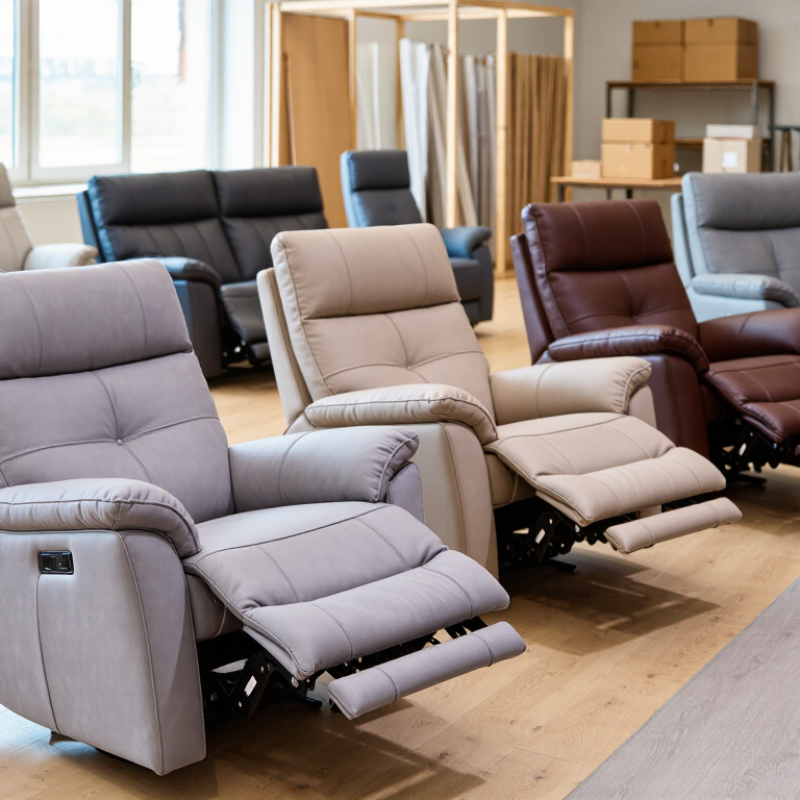
China has become a major sourcing base for Recliners Chairs, serving residential, hospitality, healthcare, and home-theater markets. Its factories offer broad customization, competitive pricing, and integrated production. These capabilities include steel mechanisms, molded foam, upholstery, motor systems, and carton packing.
Market data supports continued international interest. Fortune Business Insights valued the global recliner chair market at approximately USD 3.4 billion in 2024. Its report projects growth toward nearly USD 4.9 billion by 2032. Grand View Research also identifies rising demand for powered seating, ergonomic comfort, and space-efficient furniture. These figures matter to buyers planning private-label collections, not just large retailers.
The product is more complicated than it looks.
A reliable manufacturer must control frame strength, motor noise, cycle testing, foam density, stitching, and electrical safety. Buyers should request inspection records, material specifications, factory certifications, and sample approval before placing large orders. Small details matter. A loose cable, uneven footrest, or weak zipper can create expensive returns.
Ergonomics researcher Alan Hedge is widely associated with the practical advice, “The best posture is the next posture.” This principle explains why reclining angle, lumbar support, headrest height, and smooth movement deserve careful evaluation. A soft showroom chair may still feel uncomfortable after two hours.
China’s supplier landscape is extensive, but no factory ranking is perfect. Capability can change between production lines, seasons, and export markets. This guide examines leading Chinese Recliners Chairs manufacturers through product quality, engineering experience, customization, certifications, production capacity, and global buyer support. The goal is practical judgment, not promotional certainty.
HS 940180 generally covers other seats, including many recliner chair categories. However, customs treatment can differ by product structure and national tariff rules. Reliable buyers should compare export value, shipment quantity, destination markets, and unit prices across several years. A sudden value increase may reflect higher freight costs or premium materials, not stronger demand. China’s export network serves residential, hospitality, cinema, and care-related seating projects. Practical sourcing experience shows that frame strength, motor performance, foam density, and carton protection often influence repeat orders more than appearance alone. Even so, catalog claims need factory records and inspection evidence.
Tips: Check the latest HS tariff schedule before requesting quotations. Ask suppliers for packing dimensions, net weight, test reports, and spare-parts policies. Compare declared product specifications with commercial invoices. Small differences can affect landed cost.
Export demand is not evenly distributed. Markets with growing apartment living may favor compact recliners, while hospitality buyers often request durable upholstery and easy maintenance. Buyers should study destination-specific import data instead of relying on broad global rankings. I would also question unusually low unit values. They may indicate simplified models, incomplete data, or different product mixes. This is where careful sampling matters. Order a production sample, test the reclining cycle, and record noise, alignment, and recovery speed. Trade data provides direction, not certainty.
China’s recliner chair manufacturers offer practical options for global buyers, from simple manual models to advanced power seating. Manual recliners use a side lever or body pressure. They are affordable and usually need less maintenance. Power recliners provide smoother movement through electric motors. Buyers should confirm voltage, plug type, motor noise, and cycle testing before placing an order.
Lift recliners support users who need easier standing assistance. Check the lifting angle, weight capacity, handset design, and emergency lowering function. Massage recliners may include vibration zones, heat, and timed programs. However, stronger massage does not always mean better comfort. Ask for clear motor specifications and real usage tests. Zero-gravity models raise the legs and recline the back together. This position can reduce pressure during long sitting, but the frame must remain stable on different floor surfaces.
Material choices also affect performance. Air leather is easy to clean, while genuine leather offers a different feel and aging pattern. High-density foam should recover evenly after repeated use. In factory inspections, I would check stitching, armrest alignment, footrest gaps, and controller response. A polished sample can still hide weak internal parts. That deserves attention. Request load tests, electrical safety documents, packing photos, and replacement-part policies. Buyers should also compare seat width, seat height, carton size, and installation steps. A cheaper chair may create higher after-sales costs when specifications are unclear.
When screening recliner chair manufacturers, start with verifiable production evidence, not polished catalogs. Request the ISO 9001 certificate, accreditation details, validity dates, and covered factory address. The certificate should match the production site shown during a video call or physical audit. BSCI documentation also needs careful checking. Confirm the audit date, rating, factory name, and corrective-action status. A certificate alone does not prove daily compliance.
Capacity figures should be measured against real orders. Ask how many recliners each production line completes monthly, then compare that figure with current bookings and peak-season schedules. For example, a factory claiming 1,200 units monthly should explain its workforce, cutting area, sewing lines, and warehouse space. Request recent production records with sensitive information removed. I once trusted a capacity spreadsheet too quickly. That was a mistake. Capacity can shrink when skilled workers leave.
MOQ and lead time directly affect purchasing risk. Ask whether the MOQ applies per color, fabric, mechanism, or total order. A 50-unit MOQ may become 200 units after variations are added. Request a written timeline covering material approval, sample production, assembly, inspection, and loading. A practical supplier should separate standard and customized lead times. Confirm buffer days for foam shortages or delayed hardware. Also compare promised lead times with two recent shipment records. Numbers deserve evidence. Fair screening still requires judgment, because factory data may be incomplete or temporarily outdated.
China Top Recliner Chairs Manufacturers for Global Buyers
For global buyers, quality begins with evidence, not attractive showroom photographs. EN 12520 checks domestic seating for strength, durability, and safety. It helps assess frames, seats, backrests, and moving parts under repeated use. ISO 7173 adds structured strength and durability test methods for seating. However, neither standard should replace a product-specific evaluation.
A reliable factory should provide dated laboratory reports, test samples, and clear scope details. Ask whether the report covers the complete recliner, including the footrest and reclining mechanism. Load ratings must be stated in kilograms, with the test position and safety margin explained. Cycle tests should reflect real use, such as opening, closing, and reclining under load. A supplier may claim 30,000 cycles, but the result means little without test speed, load, failure criteria, and inspection records. In practice, loose bolts and uneven upholstery often appear before frame damage. Standards do not always reveal poor assembly.
Tips: Request a pre-shipment inspection and compare the tested sample with production units. Check hinge alignment, locking strength, noise, and cable protection by hand. Keep written acceptance limits for weight, cycles, and visible damage. A small mismatch can become a costly complaint. Test reports deserve questions, too. They are useful, but they are not perfect.
| Quality Dimension | Relevant Standard or Reference | What the Requirement or Test Covers | Recommended Buyer Data to Request | Acceptance Benchmark | Evidence |
|---|---|---|---|---|---|
| Domestic Seating Safety | EN 12520:2015 | Safety, strength and durability requirements for domestic seating, including chairs and recliners used in residential environments. | Applicable product category, test configuration, sample condition and complete laboratory report. | Pass all applicable clauses of the stated edition without structural failure or hazardous conditions. | Independent test report with standard edition and product identification. |
| Strength and Durability Method | ISO 7173:1989 | Test methods for determining the strength and durability of chairs and stools. The method does not replace product-specific safety requirements. | Loading points, applied forces, number of cycles, sequence of tests and post-test observations. | Testing must follow the specified method and the buyer’s defined pass/fail criteria. | Raw test records, photographs and signed laboratory report. |
| Reclining Mechanism | EN 13759:2012 | Operating mechanisms for seating and sofa-beds, including operating performance, strength and durability considerations. | Mechanism type, locking positions, operating force, cycle count and failure mode evaluation. | No unintended release, jamming, sharp-edge exposure or loss of locking function during testing. | Mechanism test report and engineering drawing of the tested assembly. |
| Static Seat Load | Buyer-defined specification supported by the applicable standard test method | Checks the seat frame, springs, webbing, foam support and attachment points under a concentrated or distributed load. | Rated user mass, applied test load, loading pad dimensions, dwell time and permanent deformation measurement. | Recommended declared rating: 120 kg, 150 kg or 200 kg per seat, with the exact rating stated on the product specification. | Load-test chart, deformation readings and declared maximum user mass. |
| Backrest Strength | Applicable seating strength test method | Evaluates the back frame, recliner linkage, upholstery support and connection between the backrest and seat structure. | Backrest loading direction, force or mass, number of applications and condition after testing. | No fracture, detachment, permanent loss of function or hazardous displacement. | Test setup photographs, force record and final inspection checklist. |
| Armrest Strength | Applicable seating strength test method | Checks arm supports and their connections against downward or repeated loading that may occur during sitting and standing. | Armrest test load, loading position, duration, repeated-load sequence and allowable deformation. | No cracking, loosening, detachment or sharp protrusion after the specified test sequence. | Laboratory report and inspection photographs before and after testing. |
| Opening and Closing Durability | Manufacturer or buyer cycle-test protocol; mechanism requirements should reference EN 13759 where applicable | Repeated operation of footrests, backrests, lift mechanisms or other moving parts under controlled conditions. | Cycle count, operating speed, load condition, rest intervals and functional checks at defined milestones. | Common procurement target: at least 10,000 complete operating cycles without loss of safe function; the target must be contractually defined. | Automated cycle log, maintenance record and post-test functional report. |
| Load-Rating Verification | Product technical specification and verified structural test data | Confirms that the declared maximum user mass is supported by the seat, backrest, base and reclining mechanism as a complete system. | Maximum user mass, safety factor used by the manufacturer, test load, test duration and tested configuration. | The rating must be clearly stated and must not exceed the capacity demonstrated by the complete-chair test. | Signed declaration, test report and permanent product label or packaging specification. |
| Base and Caster Stability | Applicable seating stability and strength requirements | Evaluates the base, feet or casters against tipping, cracking, loosening and instability during reclining and return movements. | Base geometry, caster type, floor surface, reclined position, applied force and stability observations. | No unacceptable tipping, component detachment or loss of controlled movement in the tested configuration. | Stability test record, base drawing and component specification. |
| Structural Materials | Technical file and material specification | Reviews frame materials, welds, fasteners, springs, webbing, plywood or solid-wood components and corrosion-sensitive parts. | Material grades, thicknesses, joint construction, fastener sizes, welding method and supplier inspection records. | Materials and joints must match the approved production sample and remain free from visible structural defects. | Bill of materials, incoming inspection records and production quality-control checklist. |
| Upholstery and Finish | Buyer specification and applicable textile or leather test methods | Assesses seam quality, abrasion resistance, colourfastness, surface defects, foam recovery and consistency between approved and bulk samples. | Cover material composition, abrasion method, colourfastness results, foam density and seam-strength data. | Bulk upholstery must conform to the approved limit samples and the agreed textile or leather performance specification. | Material test certificates, golden sample approval and pre-shipment inspection report. |
| Production Consistency | ISO 2859-1 sampling framework, where contractually adopted | Provides sampling procedures and acceptance criteria for lot-by-lot inspection; it is not a recliner performance standard. | Inspection lot size, inspection level, AQL values, critical/major/minor defect definitions and sampling plan. | Use written AQL levels agreed before production; critical safety defects should have zero acceptance. | Final inspection report with lot size, sample size, defects and disposition. |
Global buyers should treat compliance as a design requirement, not a final inspection task. UL 962 testing evaluates household electrical furniture, including wiring, motors, controls, and abnormal operation risks. CE marking requires documented conformity with applicable European rules, including electrical safety and electromagnetic compatibility. It is not simply a quality badge. RoHS controls ten restricted substances or substance groups, including lead, mercury, and selected phthalates, according to the European Commission’s RoHS framework.
Voltage planning must match the destination market. A 110–120V recliner may require different motors, fuses, plugs, and insulation than a 220–240V model. Frequency matters too. Many export designs must support 50Hz, 60Hz, or clearly separated versions. The IEA 4E Standby Power Annex reports that standby loads can represent 5–10% of household electricity use in some markets. Buyers should therefore request idle-power measurements, not only movement tests.
Ask manufacturers for traceable test reports, component lists, wiring diagrams, and production-control records. A test report is not a guarantee for every shipment. Paperwork can still miss a loose connector. That weakness deserves attention. Factory audits, sample retesting, and serial-number tracking improve reliability. Experienced suppliers should explain technical limits plainly, especially when adapting one chair platform for both voltage systems. CE documents should identify the correct model, importer responsibilities, and applicable directives. UL 962 evidence should match the actual control box and actuator configuration, not an older sample.
HS 940180 generally covers other seats, including many recliner categories. Customs treatment can vary by structure and destination rules. Check the latest tariff schedule before requesting quotations.
Compare export value, shipment quantity, destination markets, and unit prices across several years. A higher export value may reflect freight increases or premium materials. It may not show stronger demand.
Frame strength, motor performance, foam density, and carton protection matter greatly. Appearance alone can mislead buyers. Test the moving parts.
Study destination-specific import data instead of broad global rankings. Compact recliners may suit smaller apartments. Hospitality projects often need durable upholstery and easy cleaning.
Request packing dimensions, net weight, test reports, and spare-parts policies. Ask for factory records supporting catalog claims. Compare product specifications with commercial invoices.
Open and close the recliner repeatedly under realistic load. Record noise, alignment, movement speed, and recovery. A sample reveals problems photographs cannot show.
It should identify the tested product, date, load, test position, cycle speed, and failure criteria. Confirm that the complete recliner was tested. Reports are useful, but not perfect.
Check hinge alignment, locking strength, cable protection, loose bolts, and uneven upholstery. Compare production units with the approved sample. Small mismatches can create expensive complaints.
China has become a major sourcing destination for global buyers seeking reliable Recliners Chairs, supported by broad production capacity and strong export demand under HS 940180. This guide explains how to compare manual, power, lift, massage, and zero-gravity models by function, materials, dimensions, motor systems, and user requirements. It also highlights practical supplier-screening criteria, including ISO 9001 certification, BSCI participation, manufacturing capacity, minimum order quantities, production lead times, and communication efficiency.
Quality evaluation should include relevant furniture standards such as EN 12520 and ISO 7173, along with verified load ratings, durability checks, and repeated cycle testing. For international distribution, buyers should confirm electrical and safety compliance, including UL 962 or CE requirements, RoHS considerations, and compatibility with 110–120V or 220–240V systems. By reviewing specifications, documentation, testing results, and after-sales capabilities together, buyers can select suitable Chinese manufacturers with greater confidence and reduce sourcing risks.

ADS Outdoor